Disclaimer: This article is for informational purposes only and does not constitute professional financial advice. Statistics reflect the most recently available data from TransUnion and Equifax Canada. Always verify current figures and consult a qualified financial advisor for personalized guidance.
💡 Key Takeaways
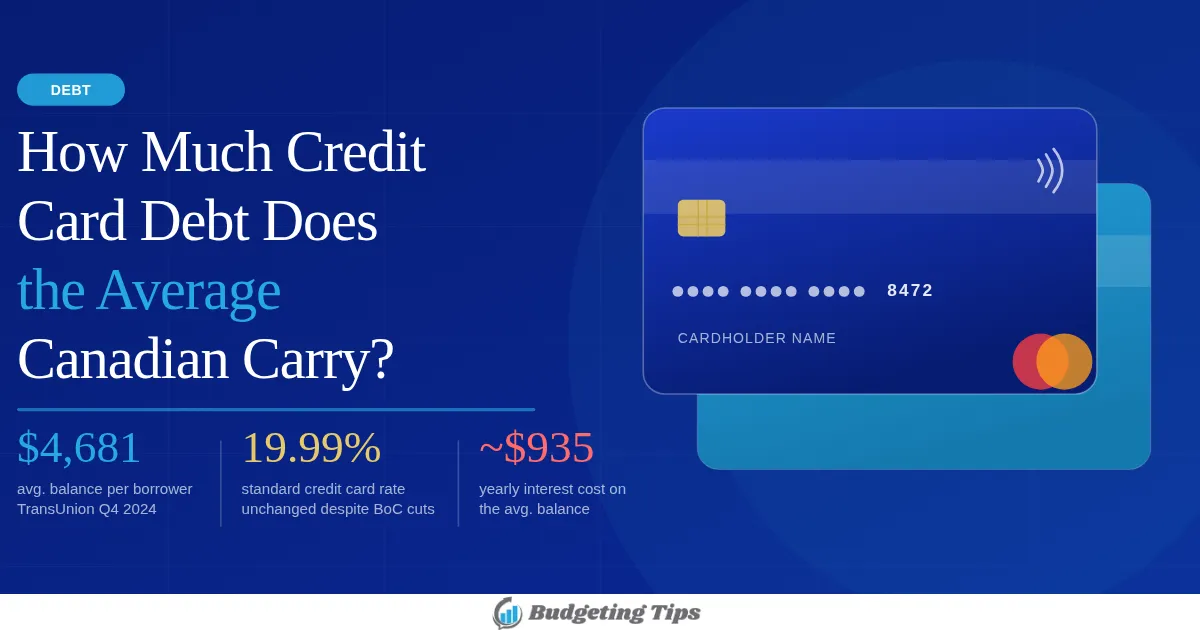
- The average Canadian credit card balance reached $4,681 in Q4 2024 (TransUnion) — an all-time high, up 6% year over year.
- Approximately 64% of outstanding balances were revolving in Q4 2024, meaning most Canadians are carrying balances from month to month rather than paying in full.
- At 19.99%, a $4,681 balance costs roughly $935 per year in interest — before a single dollar of principal is repaid.
- Ontario is Canada’s highest-stress province for consumer debt, with delinquency rates rising across all credit products.
- Bank of Canada rate cuts did not lower credit card rates — major bank cards are still at 19.99% to 22.99%.
- The Debt Payoff Planner can show you exactly how long it will take to pay off your balance — and how much interest you’ll pay — with your actual numbers.
In this article
- The current numbers
- How Ontario and your province compare
- Credit card debt by age group
- What carrying a balance actually costs you
- Why your credit card rate didn’t drop with the BoC
- The minimum payment trap
- Five steps to beat the average
- Frequently asked questions
If you are carrying a credit card balance right now, you are not alone — and you are not failing. Credit card debt in Canada has been climbing steadily for years, driven by a cost of living that outpaced wage growth, interest rates that cut into budgets, and credit products specifically designed to make carrying a balance feel manageable right up until it isn’t.
This article walks through exactly where Canadians stand as of 2026, how the numbers break down by province and age, what your balance is actually costing you in interest, and — most importantly — a clear path to getting ahead of it.
The Current Numbers
Two credit bureaus track Canadian consumer debt closely: TransUnion and Equifax Canada. They measure slightly different things — TransUnion reports average debt per borrower (people who actively carry balances), while Equifax typically reports per credit-active consumer — which is why their figures differ. Both tell the same story: balances are rising.
$4,681
Avg. balance per borrower, Q4 2024 (TransUnion)
$4,185
Avg. balance per consumer, Q1 2025 (Equifax)
$124B
Total credit card balances in Canada, Q4 2024
+9.2%
Year-over-year growth in card balances, Q4 2024
Sources: TransUnion Q4 2024 Credit Industry Insights Report; Equifax Canada Q1 2025 Market Pulse Consumer Credit Trends Report.
The standout number from Q4 2024 is the revolving rate: 64% of outstanding balances were revolving — meaning consumers carried them forward rather than paying in full — up 157 basis points from the prior year. That is the metric that matters most for interest costs, because it means the majority of Canadian credit card holders are being charged interest every single month.
⚠️ What “revolving” actually means
When a credit card balance is called “revolving,” it means the cardholder did not pay the full statement balance by the due date. The moment you carry any balance forward, your grace period disappears — interest starts accruing from the date of each purchase, not from your statement date. This is one of the least understood features of Canadian credit cards, and it is why partial payments can feel like they are barely making a dent.
How Ontario and Your Province Compare
Credit card debt is not evenly distributed across Canada. The highest average debt levels are concentrated in British Columbia, Alberta, and Ontario — the three provinces with the highest cost of living and largest urban centres. If you are in the GTA or anywhere in Ontario, you are in one of the most financially pressured regions in the country right now.
Relative debt burden by province
BC British Columbia
Highest
AB Alberta
Very high
ON Ontario
Very high
SK Saskatchewan
Above avg
MB Manitoba
Average
QC Quebec
Below avg
ATL Atlantic Canada
Lowest
Relative ranking based on Sun Life / Statistics Canada provincial non-mortgage debt data and Equifax Canada provincial reporting. Exact per-province credit-card-only figures are not publicly released at the consumer level.
Ontario’s delinquency problem
Beyond balance levels, Ontario stands out for its debt stress indicators. According to Equifax Canada’s Q1 2025 report, Ontario’s 90+ day mortgage delinquency rate rose to 0.24% — and the province is experiencing the most pronounced increase in delinquency rates across all credit products in the country. This matters for credit card holders because households under mortgage stress tend to manage that stress by leaning harder on revolving credit — which compounds the problem.
If you are in the GTA and you are carrying a credit card balance, you are in the statistical middle of one of the most financially stretched regions in Canada. That is context, not judgment — and it is also motivation.
Credit Card Debt by Age Group
Debt does not land evenly across age groups. Equifax and TransUnion both show that balances tend to peak in the 35–54 range — the years when Canadians are most likely to be managing mortgages, childcare, and career transitions simultaneously. But the fastest-growing problem is among younger Canadians.
Under 26
~$1,800
Fastest growing; new users entering at higher levels
26–35
~$3,400
Fastest decline in payment rates (Equifax)
36–45
~$5,100
Peak years; often layered with mortgage and car debt
46–55
~$5,400
Highest average; pre-retirement pressure point
56–65
~$4,200
Beginning to decline ahead of retirement
65+
~$2,900
Lower balances; higher risk on fixed income
Estimates derived from Equifax Canada age-group data and Spergel analysis of Q1 2025 Consumer Credit Trends. Figures are approximate averages including consumers with zero balances.
📌 What this means if you are 25–44
The 25–44 cohort is experiencing the fastest deterioration in payment behaviour in Canada right now, according to Equifax. This group is being squeezed by high rent or mortgage costs, student debt, and a cost of living that has only partially come down from its 2022 peak. If you are in this range and carrying a balance, you are in the demographic most at risk of letting that balance grow — and the most able to turn it around with a structured plan.
What Carrying a Balance Actually Costs You
The headline stats are useful context. But the number that really matters is what your balance is costing you in interest every year — because that is money leaving your household and going directly to a lender, producing nothing in return.
At the standard Canadian credit card rate of 19.99%, here is the annual and monthly interest cost at different balance levels:
$2,000 balance
~$400/yr
~$33 per month
@ 19.99% annual rate
$4,681 balance
~$935/yr
~$78 per month
@ 19.99% — the national average
$6,329 balance
~$1,265/yr
~$105 per month
@ 19.99% — TransUnion per-borrower avg
$10,000 balance
~$2,000/yr
~$167 per month
@ 19.99% annual rate
Figures are rough annual interest on a static balance. Actual interest is lower if you are making payments that reduce the principal over time.
Think about what $935 per year — the cost of carrying the average Canadian balance — could do instead. That is close to a full TFSA contribution for lower-income earners, or six months of grocery budgeting headroom. For a practical breakdown of how to redirect that money, see our guide on the Canadian guide to saving more money.
Why Your Credit Card Rate Didn’t Drop with the BoC
The Bank of Canada cut its policy rate seven times between June 2024 and early 2025, bringing it down from 5% to 2.75%. Variable mortgage rates came down. HELOCs came down. Lines of credit came down.
Credit card rates did not move.
Major bank credit cards are still sitting at 19.99%. Store cards and second-tier cards are at 22.99% or higher. This is not an accident or an oversight — it is structural.
💡 Why credit card rates are sticky
Credit card rates are not directly tied to the BoC policy rate the way variable mortgages are. They are set by lenders based on:
- Risk pricing: Credit cards are unsecured debt with no collateral. Lenders charge a premium to offset defaults.
- Competitive norms: Canada’s major banks have maintained rates near 19.99% for decades. No single institution has an incentive to break ranks.
- Low consumer rate sensitivity: Research shows credit card holders are relatively insensitive to rate changes compared to mortgage holders, reducing lender pressure to cut.
- Rewards program costs: Travel and cashback cards are expensive to run. Interest on unpaid balances is one of the primary ways lenders fund those programs.
The practical implication: if you are waiting for BoC rate cuts to make your credit card debt less expensive, you will be waiting indefinitely. The only rate cut that matters for your credit card balance is the one you generate yourself — by paying it down or negotiating with your lender.
📈 Related Article 10 Surprising Ways to Boost Your Credit Score →
The Minimum Payment Trap
Minimum payments are designed by lenders to be low enough that you can always afford them — and high enough that you will be paying for a very long time. In Canada, most credit card minimums are set at either a flat dollar amount (typically $10) or a small percentage of the balance (usually 2–3%), whichever is greater.
Here is what minimum payments look like on the average Canadian balance of $4,681 at 19.99%:
🐢 Minimum payments only
~$1,800
in total interest paid before the balance reaches zero
~22 years
to become debt-free on $4,681 at a 2% minimum
🚀 Fixed $250/month
~$530
in total interest paid — saving over $1,200
~22 months
to become debt-free — 20 fewer years
Estimates based on $4,681 balance at 19.99% annual rate, 2% minimum payment, no new purchases. Use the Debt Payoff Planner for your exact numbers.
The gap is not incremental — it is transformational. Paying even $150–$200 above your minimum each month dramatically compresses both the interest cost and the payoff timeline. The Debt Payoff Planner lets you enter your exact balances, rates, and payment amounts to see this for your own situation.
Free Interactive Tool — No Sign-Up Required
See your exact debt-free date and total interest paid
The Debt Payoff Planner supports both the avalanche and snowball methods. Enter your Canadian balances and rates and see your exact payoff date and total interest for each strategy — instantly.
Avalanche mode Snowball mode Canadian rates built in Your debt-free date shown
Open the Debt Payoff Planner →
Five Steps to Beat the Average
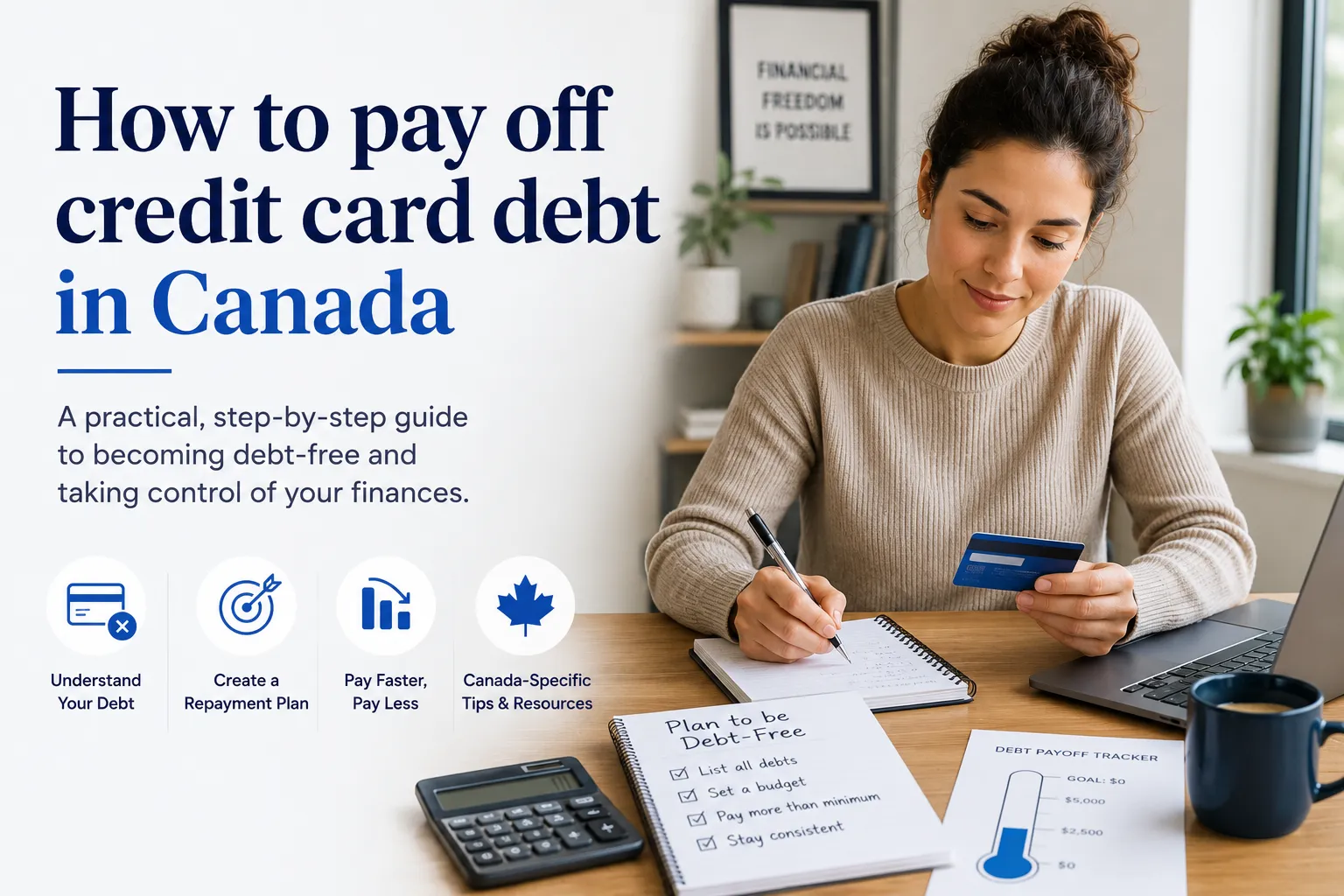
The goal is not just to understand where you stand — it is to get out ahead of it. Here is a five-step sequence built for the Canadian context.
1
Know your exact balance, rate, and minimum on every card
Log in to each card and write down three numbers: current balance, interest rate (check the card agreement — not the welcome offer rate), and the minimum payment this month. Most Canadians are surprised to find they are paying more than one rate. Store cards frequently charge 22.99–29.99%.
2
Stop adding to the balance
If you continue using the card for everyday spending while trying to pay it down, you are running to stand still. Either move to cash or debit for day-to-day purchases, or ring-fence one card for essentials and pay that balance in full each month. A solid budgeting system makes this much easier to sustain.
3
Choose your payoff method and commit to it
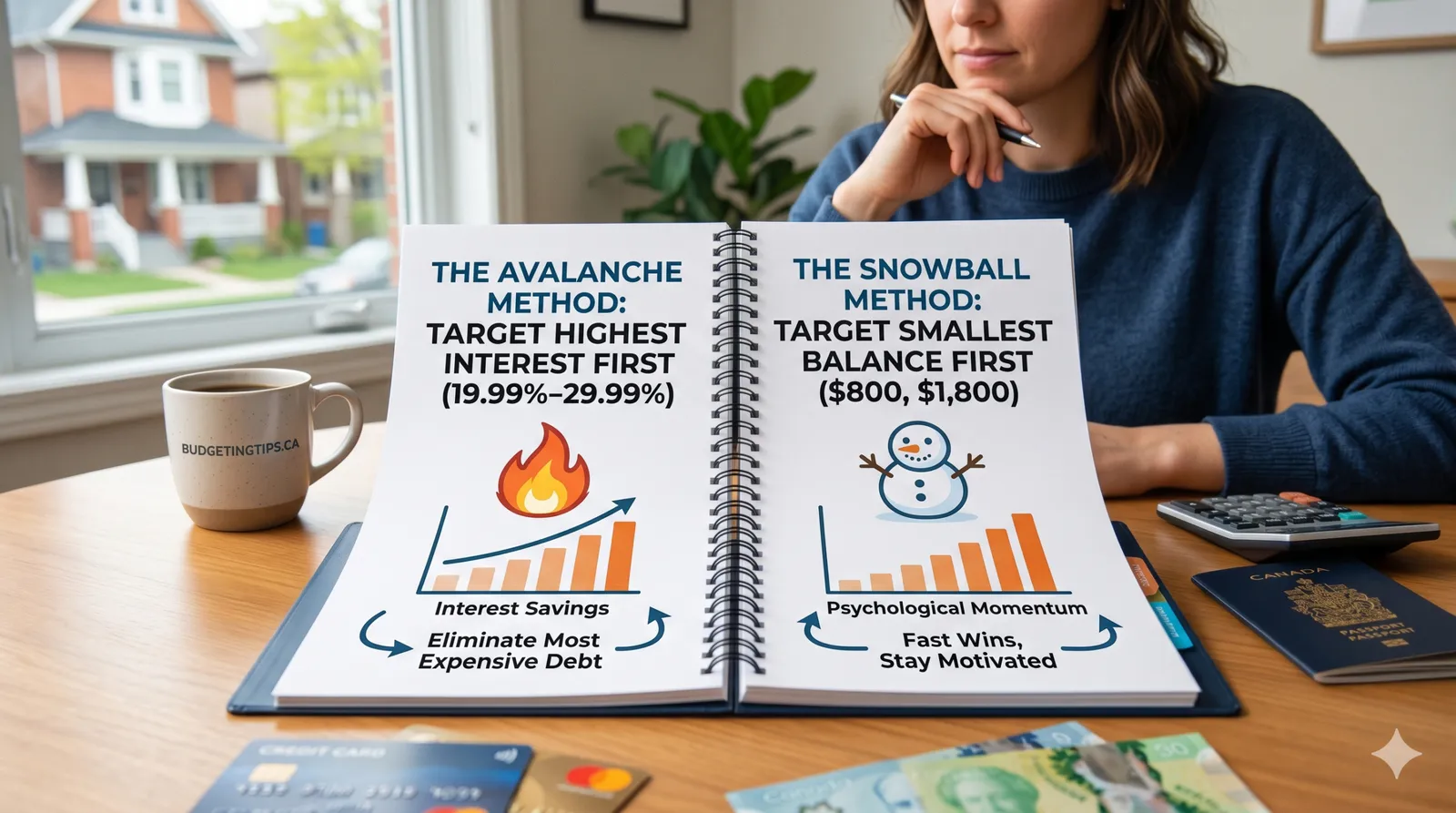
If you have more than one card, you need to choose an attack order. The two proven methods are the avalanche (highest interest rate first — saves the most money) and the snowball (smallest balance first — delivers faster wins and tends to be easier to stick with). Both work. The best one is whichever you will actually follow through on. See our full comparison: Avalanche vs. Snowball for Canadians.
4
Find $100–$200 of extra monthly payment room
Even a modest amount of extra payment above the minimum compresses the timeline dramatically. Look at three areas first: subscriptions you are not actively using, grocery spending (the GTA grocery budget guide has specific Canadian strategies), and utility bills — Ontario’s TOU and ULO electricity rates are an often-overlooked lever. You do not need to find the full payoff amount — just more than your minimum.
5
Consider a balance transfer if you qualify
Several Canadian banks offer 0% promotional balance transfer rates for 6–12 months, typically with a 1–3% transfer fee. If you can commit to paying down the transferred balance within the promotional window, this can save hundreds of dollars in interest. The critical rule: do not use the new card for purchases, and know exactly when the promotional rate expires. See our full guide on how to pay off credit card debt in Canada for a detailed walkthrough of this option.
💳 Complete Guide How to Pay Off Credit Card Debt in Canada — the full step-by-step plan →
Frequently Asked Questions
What is the average credit card debt in Canada in 2026?
The most recent data available is from Q1 2025: Equifax Canada reports an average credit card balance of $4,185 per credit-active consumer, while TransUnion’s Q4 2024 data puts the average per borrower at $4,681. Both figures represent all-time highs and reflect year-over-year growth of 6–9%.
Is $5,000 in credit card debt a lot in Canada?
It is above the national average but not unusual — particularly for Canadians in the 36–55 age group where average balances run between $5,100 and $5,400. What matters more than the absolute amount is whether you are paying it down or carrying it at 19.99%+. A $5,000 balance at 19.99% costs roughly $1,000 per year in interest.
Why didn’t credit card interest rates go down when the Bank of Canada cut rates?
Credit card rates are not directly linked to the BoC policy rate. They are set by lenders based on the unsecured risk of consumer lending, competitive norms among Canadian banks, and the cost of rewards programs. Major bank cards have remained near 19.99% for decades regardless of where the policy rate sits.
How long does it take to pay off $5,000 in credit card debt in Canada?
It depends entirely on how much you pay each month. At minimum payments only (roughly 2% of the balance), a $5,000 balance at 19.99% could take over 20 years and cost more than $2,000 in interest. At a fixed $300 per month, you would be debt-free in roughly 20 months and pay only about $580 in interest. Use the Debt Payoff Planner to run your exact scenario.
What province has the highest credit card debt in Canada?
British Columbia, Alberta, and Ontario consistently report the highest average non-mortgage debt levels, reflecting higher costs of living and larger urban populations. Within Ontario, cities including Toronto, Barrie, and Peterborough rank among the highest for per-capita credit card debt nationally.
Should I use my TFSA or pay off credit card debt first?
In almost all cases, pay off high-interest credit card debt first. Earning 4–5% in a TFSA while paying 19.99% on a credit card is a guaranteed net loss of roughly 15 percentage points. Once your credit cards are paid off, your TFSA becomes a powerful tool for building the emergency fund that helps you avoid going back into credit card debt. See our guide to TFSA, RRSP, and FHSA in Canada for how these accounts fit together in a broader plan.
What is a dangerous level of credit card debt?
Most financial professionals use credit utilization as the benchmark: using more than 30% of your total available credit limit is considered elevated and will begin to affect your credit score. A more practical threshold is whether your monthly minimum payments on all debts exceed 15–20% of your take-home pay — at that point, the debt is competing meaningfully with your ability to save or cover unexpected expenses.
Ready to see your debt-free date?
Model your payoff plan with your actual Canadian numbers — free
Enter your balances, rates, and monthly payment into the Debt Payoff Planner and get your exact debt-free date and total interest paid. Takes two minutes. No sign-up required.
Open the Debt Payoff Planner →
Related Articles
❄️ Debt Payoff Avalanche vs. Snowball: Which debt payoff method works better for Canadians? → 💳 Debt Payoff How to pay off credit card debt in Canada: the complete step-by-step guide → 💰 Saving Money The Canadian guide to saving more money — find the extra dollars to accelerate your payoff → 🏦 Next Step After Debt Canada’s registered accounts explained: TFSA vs. RRSP vs. FHSA — where to put your money once you’re debt-free →