One in four Canadians couldn’t cover a surprise $500 expense. That’s from a Statistics Canada survey, and it lines up with what I see. A dead alternator or a cracked tooth shouldn’t be a financial crisis. But without a cushion it goes on a credit card at 20%, and now a $500 problem is a $600 problem that lasts all year.
An emergency fund is the cushion. It’s the first thing I would build, before investing, before paying extra on the mortgage. Like a foundation under a house, everything else you do with money sits on top of it.
The usual advice is “save three to six months of expenses.” It’s good advice. But it’s also the reason a lot of people never start, because that sounds like $20,000 and they have $200. So let’s work out your real number, and then break it into pieces you can actually hit.
How much do you need?
Your number is based on your essential expenses, not your income and not your total spending. Essentials are the bills you would still have to pay if your paycheque stopped tomorrow.
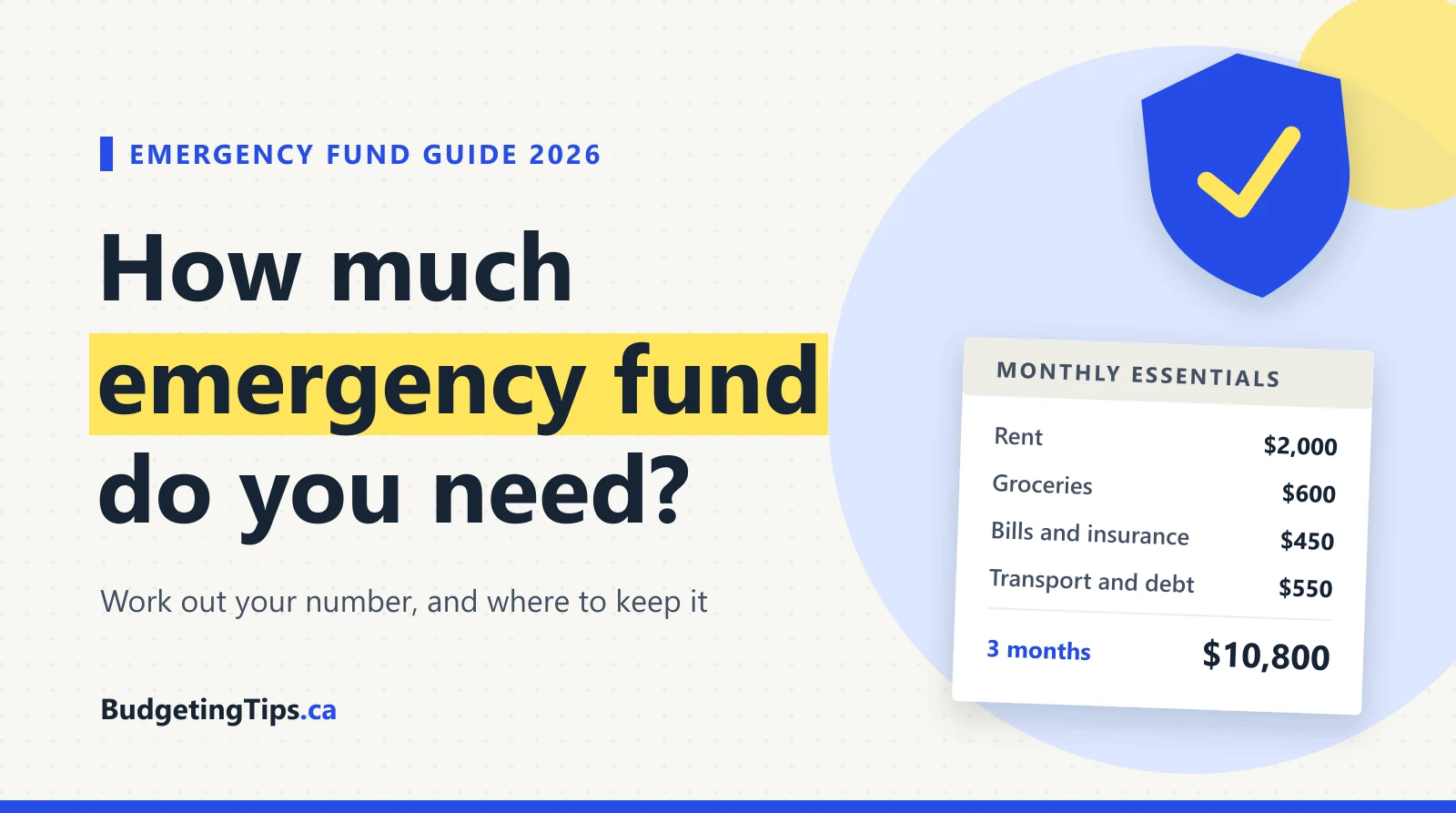
Here’s an example for a renter in Ontario:
| Essential expense | Monthly |
|---|---|
| Rent | $2,000 |
| Groceries | $600 |
| Utilities, phone and internet | $300 |
| Transportation | $350 |
| Insurance | $150 |
| Minimum debt payments | $200 |
| Total | $3,600 |
Notice what’s not on the list. No restaurants, no streaming, no vacations, no gifts. In a real emergency those are the first things you’d cut.
So for this person, three months is $10,800 and six months is $21,600. That’s a lot less than three to six months of income, and that’s the point. You’re not trying to replace your lifestyle. You’re trying to keep the lights on.
To get your own number, pull your last three months of statements and add up only the essentials. The monthly budget calculator will do the sorting for you.
Three months or six?
It depends on how shaky your income is and how many people depend on it.
| Your situation | Aim for |
|---|---|
| Steady job, two incomes in the house | 3 months |
| Steady job, one income, or you have kids | 4 to 6 months |
| Self-employed, commission, contract or seasonal work | 6 months |
| Retired, living on pensions and savings | 6 to 12 months of the gap your pensions don’t cover |
If you freelance, your income already goes up and down in a normal year, so your fund has to cover slow months as well as real emergencies. I go through that in the freelancer’s budgeting guide.
Won’t EI cover me if I lose my job?
Not by itself. A lot of people overestimate this one.
Employment Insurance pays 55% of your insurable earnings, up to a maximum of $729 a week in 2026. That’s about $3,160 a month, and it’s taxable. If you earn $70,000 a year, your gross pay is about $5,830 a month. So even at the maximum, EI replaces barely half.
It also doesn’t start right away. There’s a one-week waiting period with no pay, and the first payment usually takes a few weeks to arrive after you apply. And if you quit, were let go for cause, or you’re self-employed and never opted in, you may get nothing.
So EI is part of the plan, but it isn’t the plan. In the example above, EI at the maximum would leave that renter about $440 a month short before tax, and with nothing at all for the first month. The emergency fund covers the gap.
Build it in three stages
Don’t aim for $10,800. Aim for the next stage. Baby steps is the answer here.
Stage 1: A $2,000 starter fund. This covers most of the things that actually go wrong: a car repair, a vet bill, a broken appliance, a flight home. At $50 a week you’re there in 40 weeks. At $100 a week it’s under five months.
Stage 2: One month of essentials. In our example that’s $3,600. Now a missed paycheque or a gap between jobs doesn’t put you behind on rent.
Stage 3: Three months, then six if you need it. This is the full fund. At $300 a month it takes about two years to get from $3,600 to $10,800. That’s fine. It’s supposed to take a while.
A few things that make it faster:
- Automate it. Set up a transfer for the day after payday. If the money never sits in your chequing account, you don’t miss it.
- Send windfalls straight there. Tax refund, a bonus, the Canada Groceries and Essentials Benefit payment. One $1,500 tax refund is most of Stage 1.
- Find one expense to cut and redirect it. Not ten. One. A cancelled subscription or a cheaper phone plan is $30 to $50 a month, every month. There are more ideas in 30 ways to save money.
- Keep going after a withdrawal. You will use it. That’s what it’s for. When you do, restart the transfers and fill it back up.
Should you pay off debt first?
Do a little of both, in this order:
- Save the $2,000 starter fund. Even if you have credit card debt. Without it, the next surprise goes right back on the card and you never get ahead.
- Then go after high-interest debt. A credit card at 20% costs you far more than a savings account pays. Put every extra dollar there until it’s gone. See how to pay off credit card debt in Canada and the debt payoff planner.
- Then finish the fund. Once the card is paid off, take the payment you were making and point it at Stage 2 and Stage 3.
Low-interest debt like a mortgage or a student loan doesn’t need to be paid off first. Keep making the regular payments and build the fund alongside it.
Where should you keep it?
An emergency fund has one job: be there when you need it. So it needs to be safe, and you need to be able to get at it in a day or two. Earning interest is a bonus, not the goal.
A high-interest savings account. This is my first choice. No fees, no lock-in, and you can move the money to chequing in a day. Online banks and credit unions usually pay more than the big banks’ basic savings accounts. I won’t quote a rate because they change every few months, but watch out for promotional rates that drop after three to five months. The ongoing rate is the one that matters.
A savings account inside your TFSA. Same account, but the interest is tax-free. This is a good home for it if you aren’t using your TFSA room for investing. One thing to know: when you take money out, the room doesn’t come back until January 1 of the next year, so don’t put it back in the same year unless you have spare room.
A cashable GIC, for part of it. Once you’re past Stage 2, you can put a portion in a cashable or redeemable GIC for a slightly better rate. Not a locked-in GIC. If you can’t get the money out early, it isn’t an emergency fund.
I’d keep it at a different bank from your chequing account. If it shows up next to your spending money every time you log in, it gets spent. A day’s delay to transfer it is a feature.
Eligible deposits at banks that are members of the Canada Deposit Insurance Corporation are covered up to $100,000 per category, and a TFSA counts as its own category. Credit unions are covered by provincial insurers. Either way your fund is protected if the institution fails.
Where not to keep it
Not in stocks or ETFs. Markets tend to drop at the same time people lose their jobs. If your fund is down 25% the month you get laid off, you have to sell at the worst possible time.
Not in your RRSP. Withdrawals are taxed as income, the bank holds back tax on the way out, and you never get that contribution room back.
Not in your chequing account. It earns nothing and it’s too easy to spend.
Not on a line of credit. I hear this one a lot: “I don’t need a fund, I have a line of credit.” A line of credit is a debt, not savings. You pay interest from day one, and the bank can cut your limit whenever it wants, which usually happens right when times get hard. It’s a fine backup behind your fund. It’s not a replacement for one. And if the alternative is a payday loan, read payday loan alternatives in Canada first.
What counts as an emergency?
Ask three questions. Is it unexpected? Is it necessary? Is it urgent? If all three are yes, use the fund and don’t feel bad about it.
- Yes: job loss, a car repair you need to get to work, an emergency dental or vet bill, a furnace that dies in January, a last-minute flight for a family emergency.
- No: a vacation, a sale, Christmas, car insurance, property tax, new tires you knew were coming.
That second list isn’t emergencies, it’s irregular bills (here’s how to plan a holiday budget, for one). You know they’re coming, you just don’t know exactly when. Those belong in a separate savings bucket that you fill a little each month. If you mix the two, the “emergency” fund gets drained every December and it’s never there for a real one.
Start this week
Open a savings account at a different bank from your chequing account. Set up an automatic transfer for the day after payday, even if it’s $25. Then add up your essentials so you know what Stage 2 looks like.
That’s it. The first $2,000 is the hardest and it does the most good. Once it’s there, a flat tire is just an annoying Tuesday, and not something you’re still paying for in the spring.
This article uses 2026 Employment Insurance figures. It’s general information, not personal financial advice, and savings rates and account terms change often, so check with the institution before you open an account.
Related guides
- How Much Should I Be Saving Each Month in Canada?
- How to Build a Budget That Actually Sticks
- How to Pay Off Credit Card Debt in Canada
- TFSA Contribution Room
Frequently asked questions
How much should I have in an emergency fund in Canada?
Three months of essential expenses if you have a steady job and a second income in the house. Six months if you are self-employed, on commission, or the only earner. Essential expenses means rent or mortgage, groceries, utilities, transportation, insurance and minimum debt payments, not your full spending.
Should I pay off debt or build an emergency fund first?
Do a small one first. Save a starter fund of about $2,000, then put everything extra toward high-interest debt like credit cards. Once that debt is gone, go back and build the fund up to three months.
Should I keep my emergency fund in a TFSA?
A savings account inside a TFSA is a good place for it, because the interest is tax-free and you can take the money out any time. Keep it in a savings account or cashable GIC inside the TFSA, not in stocks. Remember that the room from a withdrawal only comes back on January 1 of the next year.
Is a line of credit a good emergency fund?
No. It is a backup, not a fund. A line of credit is borrowed money that charges interest, and the bank can lower the limit or cancel it, often at the same time the economy turns and you need it most.
Is Employment Insurance enough to live on if I lose my job?
Usually not. EI pays 55% of your insurable earnings up to a maximum of $729 a week in 2026, and it is taxable. There is a one-week waiting period and it takes a few weeks for the first payment to arrive. An emergency fund covers the gap.
What counts as an emergency?
Something unexpected, necessary and urgent: a job loss, a car repair you need to get to work, an emergency vet or dental bill, a broken furnace. A vacation, a sale, or an annual bill you knew was coming is not an emergency.