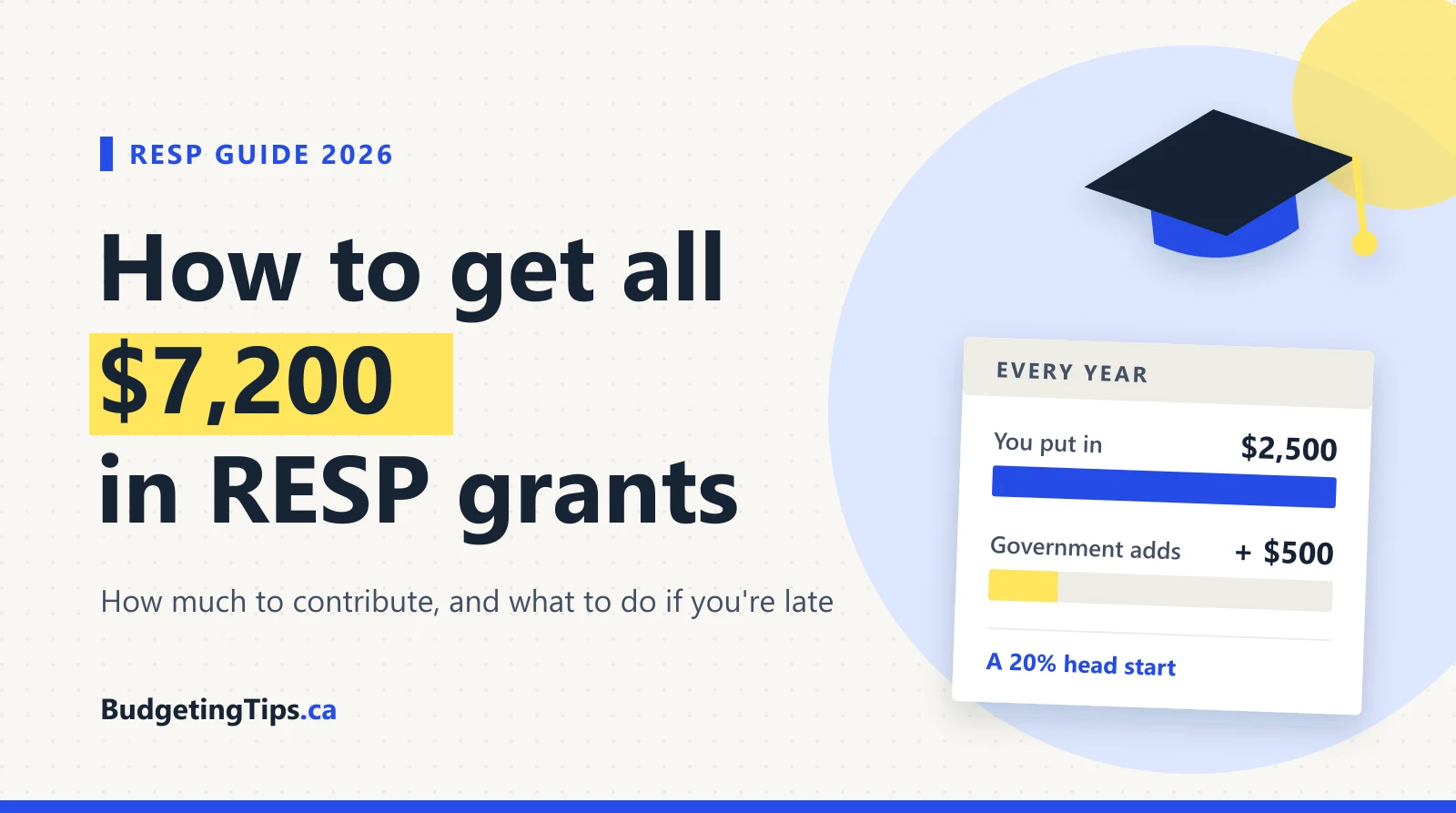
Put $2,500 into an RESP and the government adds $500. That’s a 20% return on the day you make the deposit, before the money is even invested. I have always been an advocate of taking free money when it’s offered, and there isn’t a better deal than this one for a Canadian parent.
But a lot of families never open one. Some think they need thousands of dollars to start. Some worry about what happens if their kid doesn’t go to university. And some just never get around to it, and every year they wait is $500 they have to work harder to get back.
So here is how the RESP works, how much to put in, and what to do if you’re starting late.
What is an RESP?
A Registered Education Savings Plan is an account for saving for a child’s education after high school. University, college, trade school, apprenticeships, they all count.
Three things make it worth using:
- The government adds to it. At least 20% on the first $2,500 a year, and more if your income is lower.
- It grows tax-free. You pay no tax on the growth while the money is in the plan.
- The student pays the tax, not you. When the money comes out, the grants and the growth are taxed as the student’s income. Most students earn so little that the tax is zero or close to it.
Your contributions are not tax deductible. That’s the difference from an RRSP. You put in after-tax money, and you get it back tax-free.
How much free money can you get?
There are three federal programs, and you can get more than one.
| Program | What you get | Who gets it |
|---|---|---|
| Canada Education Savings Grant (CESG) | 20% on the first $2,500 a year. $500 a year, $7,200 lifetime. | Every child, any income |
| Additional CESG | An extra $100 a year on the first $500 you contribute | Family income of $58,523 or less |
| An extra $50 a year on the first $500 you contribute | Family income from $58,523 to $117,045 | |
| Canada Learning Bond (CLB) | $500 the first year, then $100 a year to age 15. $2,000 lifetime. No contribution needed. | Lower-income families |
Income thresholds are for 2026 and are indexed every year. The Additional CESG counts toward the same $7,200 lifetime limit.
The basic grant is the big one. $2,500 in, $500 added. If you can’t manage $2,500, you still get 20% on whatever you put in. $50 a month is $600 a year, and that gets $120.
The Additional CESG is easy to miss. If your family net income is $58,523 or less, the first $500 you contribute gets 40% and not 20%. So $500 in gets $200. You have to ask for it on the application when you open the plan.
The Canada Learning Bond needs no money from you at all. If your family income is about $58,500 or less (the limit is higher with four or more children), the government puts in $500 the first year your child qualifies and $100 for every year after, up to age 15. You don’t have to contribute a cent. You just have to open an RESP and apply. A lot of eligible families never claim it, and that’s $2,000 sitting unclaimed for no reason.
Some provinces add their own. Quebec adds 10% on the first $2,500 (up to $250 a year), and B.C. has a one-time $1,200 grant you apply for between your child’s 6th and 9th birthday. Ontario doesn’t have one.
How much should you put in?
$2,500 a year per child. That’s $208 a month. That is the number that gets the full $500 grant every year. Do it for 14 years, add a $1,000 top-up in year 15, and you have collected all $7,200.
Here’s what that looks like by age 18, assuming a 5% average return:
| What you do | You put in | Grants | Value at 18 |
|---|---|---|---|
| $2,500 a year from birth, until the grant is maxed | $36,000 | $7,200 | about $76,500 |
| $100 a month from birth to 17 | $21,600 | $4,320 | about $42,500 |
| Nothing until age 10, then $5,000 a year | $36,000 | $7,200 | about $55,100 |
Look at the first and third rows. Same $36,000 from you, same $7,200 from the government, and a difference of more than $21,000. That’s what starting early is worth. The money you put in when your child is a baby has 18 years to grow, and the money you put in at 15 has three.
And look at the second row. $100 a month isn’t the maximum, and it still gets over $4,300 in grants. If $208 a month isn’t possible right now, start with what you can. Start small. $25 a month still gets 20% added to it, and you can raise it later.
For context, Statistics Canada puts average undergraduate tuition at about $7,700 a year. Four years is about $31,000 before books, rent and food. So that first row covers a degree and a good part of the living costs.
Should you put in more than $2,500? You can. There’s no annual limit, only a lifetime limit of $50,000 per child. But anything over $2,500 a year earns no grant (unless you’re catching up). I’d fill your TFSA before I put extra into an RESP, because the TFSA has no strings on what the money is used for.
Where does the $208 a month come from?
For a lot of families, the answer is the Canada Child Benefit. The CCB pays up to $679 a month for a child under 6. Move $208 of that straight into the RESP on the day it arrives and you never see it, and you never miss it.
If you want to go one step further, an RRSP contribution can raise your CCB, and that extra CCB can fund the RESP. I worked through the numbers in the CCB and RRSP connection. And if daycare is eating the budget right now, see how the $10-a-day childcare subsidy works, because the money that frees up is a natural fit for this.
What if you started late?
You can catch up, but there’s a speed limit. Unused grant room carries forward from the year your child was born, but the most you can collect in one year is $1,000. That takes a $5,000 contribution.
So if your child is 6 and you’ve never contributed, you have $3,500 of grant room built up. You can’t put in $17,500 this year and collect it all. You put in $5,000, get $1,000, and do the same next year.
Two dates matter here:
- The year your child turns 10. This is the last point where you can start from zero and still get the full $7,200, and it takes $5,000 a year to do it. Start at 11 and the most you can get is $7,000. It shrinks every year after that.
- December 31 of the year your child turns 15. To get any grant at 16 and 17, the plan needs at least $2,000 in contributions by this date, or at least $100 a year in any four years before it. Miss this one and the grant is gone for good.
The grant stops at the end of the year your child turns 17. And every grant year ends on December 31, so if you’re catching up, get this year’s contribution in before then. It’s on my year-end money checklist for that reason.
How to open an RESP
- Get your child a Social Insurance Number. You can’t open an RESP without one. It’s free through Service Canada, and you can apply when you register the birth.
- Pick a provider. Banks, credit unions, online brokerages and robo-advisors all offer them.
- Choose a family plan or an individual plan. A family plan can hold all your children in one account, and you can move money between siblings. If you have or plan to have more than one child, I’d pick the family plan.
- Tick the boxes for every grant. The application asks which grants you want. Ask for all of them, including the Additional CESG and the Canada Learning Bond. If you don’t ask, you don’t get them.
- Set up an automatic monthly contribution. $208, or whatever you can do. Automatic is the whole point. If you have to remember to do it, you won’t.
A word on group plans. You’ll see “group RESPs” or “scholarship plans” sold by dealers who often reach out to new parents. I am not a big fan of these. Many charge enrolment fees up front, lock you into a contribution schedule, and can cost you if you stop early. A regular RESP at your bank or an online brokerage gets exactly the same government grants with far fewer rules. Ask about every fee before you sign anything.
How do withdrawals work?
When your child enrols in a qualifying program, the money comes out in two ways.
Your contributions. These come back tax-free, to you or to the student. There’s no limit on how much you take.
Educational Assistance Payments (EAPs). This is the grants and the growth. It’s taxed as the student’s income. A student can earn $16,452 in 2026 before paying any federal tax, and that’s before the tuition credit. So for most students the tax on this is nothing. For a full-time student there’s an $8,000 limit on EAPs in the first 13 weeks of school. After that there’s no limit.
Here’s the thing: take the EAP money out first. Use up the grants and the growth while your child is a student with a low income. Your own contributions can come out any time, tax-free, even after they finish.
What if your child doesn’t go?
This is the worry I hear the most, and it stops a lot of people from opening one. It shouldn’t. You have options, and none of them cost you the money you put in.
- Wait. The plan can stay open for 35 years. A lot of kids who don’t go at 18 go at 22.
- Give it to a sibling. In a family plan, a brother or sister can use the money, including the grants, up to their own $7,200 limit.
- Take your contributions back. Tax-free. They were always yours.
- Move the growth to your RRSP. Up to $50,000, if you have the contribution room, the plan has been open at least 10 years and your child is 21 or older. No tax at the time.
- Take the growth as cash. This is the expensive one. It’s taxed at your marginal rate plus an extra 20%.
The grants themselves go back to the government. So the worst case is this: you get every dollar back, you keep the growth (with tax on it), and you return money that was never yours to begin with. That’s not much of a risk for a 20% head start.
The short version
Open the RESP. Ask for every grant on the form. Set up $208 a month per child, or whatever you can manage, and let it run. If you’re behind, put in $5,000 a year until you’ve caught up. And get it in before December 31.
If you’re not sure where the money fits, start with the guide to budgeting for families and run your numbers through the monthly budget calculator. You’ll usually find the $208. It’s often sitting in the CCB deposit.
This article uses 2026 grant amounts and income thresholds. Growth figures assume a 5% average annual return and are examples, not a promise. It’s general information, not personal financial advice. Check canada.ca for current figures.
Related guides
- Year-End Money Checklist for Canadians
- The CCB and RRSP Connection
- TFSA vs RRSP vs FHSA
- Personal Finance Tips for Single Parents in Canada
Frequently asked questions
How much should I put in an RESP each year?
$2,500 per child, which is about $208 a month. That gets the full $500 Canada Education Savings Grant for the year. Do that for 14 years plus one $1,000 top-up and you collect the lifetime maximum of $7,200.
Can I catch up on RESP grants I missed?
Yes, but only one year at a time. Unused grant room carries forward, and you can collect up to $1,000 of grant in a year by contributing $5,000. If you start by the year your child turns 10 and contribute $5,000 a year, you can still get the full $7,200.
What happens to the RESP if my child doesn't go to university or college?
You get your contributions back tax-free. The grants go back to the government. The investment growth can be moved into your RRSP (up to $50,000, if you have the room) or taken as cash, which is taxed at your marginal rate plus an extra 20%. You can also name a sibling as the new beneficiary, and the plan can stay open for 35 years.
Is there a limit on RESP contributions?
There is no annual limit, but there is a lifetime limit of $50,000 per child. Only the first $2,500 a year earns the basic grant, or $5,000 if you are catching up on a missed year.
Can I get RESP money without contributing anything?
Yes, if your family income is low enough. The Canada Learning Bond pays $500 in the first year and $100 a year after that until age 15, up to $2,000, with no contribution needed. You just have to open an RESP and apply.
Are RESP withdrawals taxed?
Your contributions come out tax-free. The grants and the growth are taxed in the student's hands, and most students have so little income that they pay little or no tax on it.