Canadians planned to spend an average of $1,675 on gifts, travel and entertainment last holiday season, according to PwC’s holiday outlook. That’s a lot of money to spend without a plan. And most of us do spend it without a plan, a gift here, a party there, and then the credit card statement shows up in January.
Here’s what that costs. Put $1,500 of holiday spending on a card at 19.99% and pay it back at $75 a month. It takes 25 months and about $340 in interest. So you’re still paying for this Christmas when the next one has come and gone, and the one after that is on its way.
I am not telling you to skip the holidays. I am telling you to set the number first. One number, written down, before you buy the first gift. That’s the whole idea, and the rest of this is how to do it.
Step 1: How much can you actually spend?
Most people start with the list and add it up. That’s backwards. Start with the money.
Your holiday budget is two things added together:
- What you have already set aside for the holidays.
- What you can pull from each paycheque between now and December 25, after the regular bills are paid.
So if you have $300 saved and you can spare $150 from each of your next five paycheques, your budget is $300 + $750 = $1,050. That’s the number. Not what you spent last year, not what your sister-in-law spends, not the national average.
If you get paid every two weeks and it’s already early November, you only have three or four paycheques left. That’s why the earlier you do this the better. If you’re not sure what you can spare, run your month through the monthly budget calculator first.
And one rule: your emergency fund is not part of this. Christmas comes on the same day every year. It isn’t an emergency.
Step 2: Split it up
Gifts are the part everyone thinks about. They’re also only part of the bill. Here’s how I would split that $1,050:
| Category | Share | Amount |
|---|---|---|
| Gifts | 60% | $630 |
| Food and hosting | 20% | $210 |
| Travel | 10% | $105 |
| Everything else | 10% | $105 |
Change the shares to fit your holiday. If you’re flying home, travel might be half of it and the gifts get smaller. But make sure every category has a number.
”Everything else” is where budgets get blown, because none of it feels like spending at the time. Watch for:
- Wrapping paper, cards, stamps and shipping
- The tree and decorations
- Work parties, Secret Santa and the gift exchange you forgot about
- Teacher, coach and daycare gifts
- New outfits and holiday photos
- Charity and the donation jar at the checkout
None of these is big. Together they’re $100 to $200 that nobody planned for.
Step 3: Write the gift list, with dollar amounts
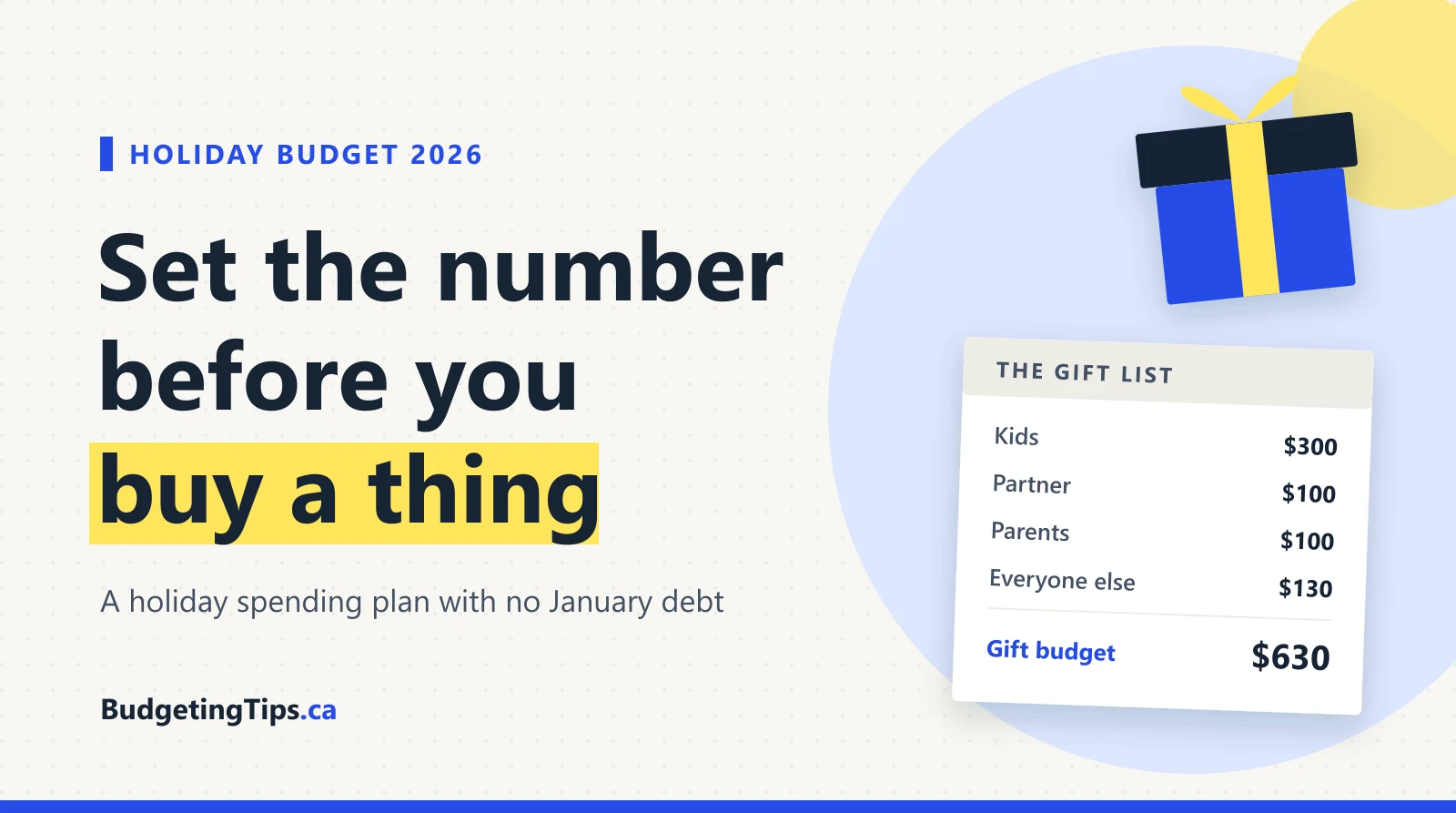
A list of names isn’t a budget. A list of names with a number beside each one is. Here’s $630:
| Who | Amount |
|---|---|
| Kids (2) | $300 |
| Partner | $100 |
| Parents (2) | $100 |
| Sibling (drew one name) | $50 |
| Teachers (2) | $40 |
| Secret Santa at work | $25 |
| Buffer | $15 |
| Total | $630 |
The total has to match your gift number from Step 2. If it comes out higher, you don’t raise the budget. You lower an amount or take a name off. That’s the hard part and it’s the part that matters.
Keep the list on your phone. When you buy something, write down what you actually paid. If you went $20 over on one person, take $20 off someone else right then, not later.
Step 4: Shrink the list, not the gifts
The fastest way to spend less is to buy for fewer people. It’s also the one most families are quietly hoping somebody else will suggest.
- Draw names. Each adult buys for one adult, not all of them. In a family of six adults that’s one $50 gift each, not five.
- Kids only. The adults agree to skip gifts for each other and buy for the children.
- Set a limit. Agree on a number, like $25 a person. Everyone is relieved and nobody has to guess.
- Give time. A night of babysitting, a home-cooked dinner, a framed photo. These cost little and they’re the gifts people remember.
Bring it up now and not on December 20. A text in the family group chat that says “should we draw names this year?” takes one minute, and it can take a few hundred dollars off the list.
Step 5: Shop the sales without getting played
Black Friday is November 27, 2026 and Cyber Monday is November 30. Boxing Day is Saturday, December 26, if you’re buying for yourself or getting a head start on next year.
Sales are great when they lower the price of something already on your list. They’re a problem when they put new things on it. A $200 item for $120 doesn’t save you $80 if you weren’t going to buy it. It costs you $120.
- Shop from the list. If it isn’t on the list, it isn’t a deal.
- Check the regular price. Some “sale” prices are the same price it was in October. Look at a couple of stores before you believe the sticker.
- Use flyer and price-match apps. A lot of Canadian stores will match a competitor’s advertised price. See which stores price match in Canada.
- Cash in your points. Loyalty points you’ve been collecting all year are real money. December is a good time to spend them.
- Count the shipping. Free shipping minimums are designed to make you add one more thing. Add it up before you check out.
- Buy early for anything you’re mailing. Rush shipping in the last week can cost more than the gift.
Step 6: Pay for it without borrowing
Debit or cash is the simplest. Move your holiday budget into a separate account and spend from that. When it’s empty, you’re done. Some people take out cash and use envelopes for each category, and I like that for anyone who finds a card too easy to tap.
A credit card is fine, on one condition. You pay the full balance when the statement arrives. If you’re using it for the points and the money is already sitting in your account, go ahead. If you’re using it because the money isn’t there, that’s borrowing, and 19.99% is an expensive way to buy a sweater.
I am not a big fan of buy now, pay later. Four small payments feels like nothing. But four small payments on six different purchases is a second set of bills arriving in January and February, on top of the regular ones. If you can’t pay for it today, the plan doesn’t make it cheaper. It just moves it to a month when you’ll have forgotten about it.
Food, hosting and travel
Host potluck style. You do the turkey, everyone else brings a side or a dessert. Send a list so you don’t get five bowls of mashed potatoes. People like being asked, and it can cut the cost of the meal in half.
Plan the menu around the flyers. Turkeys, hams and baking supplies go on sale in the weeks before the holidays, so buy them when the price is low and freeze what you can. There’s more in how to save money on groceries.
Book travel early. Flights and trains around December 23 and 27 only get more expensive. If your dates are flexible, flying on the day itself or a few days either side is usually cheaper. I have more on this in the guide to vacation budgeting.
The best parts are free anyway. Skating at the outdoor rink, driving around to look at the lights, a movie night at home, the Santa Claus parade. Nobody’s favourite holiday memory is how much was spent.
What if you already overspent?
Then deal with it in January, not in June.
Add up what’s on the cards and make a plan to clear it in three months or less. Put it into the debt payoff planner to see what the payment has to be, and cut back hard until it’s gone. If it’s more than you can clear in a few months, how to pay off credit card debt in Canada walks through the options.
And don’t beat yourself up. Use it. The number on that statement is exactly what you need for the next section.
Next year: never scramble again
Here’s the real fix. Take what you spent this year, divide it by 12, and start saving it in January.
- A $1,200 holiday is $100 a month, or about $46 every two weeks.
- A $600 holiday is $50 a month.
Open a separate savings account, name it “Holidays,” and set up an automatic transfer for the day after payday. That’s it. This is called a sinking fund, which is just a fancy name for saving a little at a time for a bill you know is coming.
By next November the money is sitting there. You’re not counting paycheques, you’re not reaching for the card, and Black Friday is just shopping. Add it to your list when you review your year-end money, and set up the transfer before the decorations come down.
More budgeting and savings guides
- 30 Ways to Save Money in Canada
- How to Build a Budget That Actually Sticks
- Emergency Fund in Canada
- Guide to Budgeting for Families
Frequently asked questions
How much should I spend on the holidays?
Only what you can pay for with money you already have plus what you can set aside from your paycheques before December 25. Add those up and that is your budget. If the number is $600, the budget is $600, whatever the average Canadian is spending.
How do I make a holiday budget?
Set one total first. Split it into gifts, food and hosting, travel, and everything else. Then write a gift list with a name and a dollar amount beside each one, and make sure the list adds up to your gift number before you start shopping.
When are Black Friday and Cyber Monday in 2026?
Black Friday is November 27, 2026 and Cyber Monday is November 30, 2026. Boxing Day is Saturday, December 26.
Should I put holiday shopping on a credit card?
Only if you will pay the full balance when the statement comes. A $1,500 balance at 19.99% takes 25 months to clear at $75 a month and costs about $340 in interest. If you can't pay it in full, use debit or cash and spend less.
How do I save for Christmas next year?
Take what you spent this year, divide by 12, and set up an automatic transfer to a separate savings account starting in January. A $1,200 holiday is $100 a month, or about $46 every two weeks.
How can I cut holiday costs without it feeling cheap?
Shrink the list, not the gifts. Draw names among the adults, agree on a spending limit with family, buy for the kids only, and host potluck style. Most people are relieved when someone suggests it.