If you are a parent in Ontario trying to balance your family budget, you’ve undoubtedly been tracking the rollout of the Canada-Wide Early Learning and Childcare (CWELCC) system. The provincial promise of universal “$10-a-day childcare” sounds amazing in news headlines, but if you’ve recently looked at your daycare bills or tried to secure a spot, you know the reality on the ground feels a bit more complicated.
Base fees across the province have officially been capped, but navigating waitlists, aging-out rules, and regional subsidies can still make your head spin. Let’s break down exactly how the CWELCC framework impacts your wallet right now, and how to optimize your family budget around it. For full household spending plans, explore our Guide to Budgeting for Families and test your numbers in our Monthly Budget Calculator.
1. The Fee Cap: What Are You Actually Paying?
The ultimate goal of the program is to hit an average of $10-a-day by the end of the rollout. However, the system currently operates on a legislated fee cap system rather than a flat rate for everyone across the board.
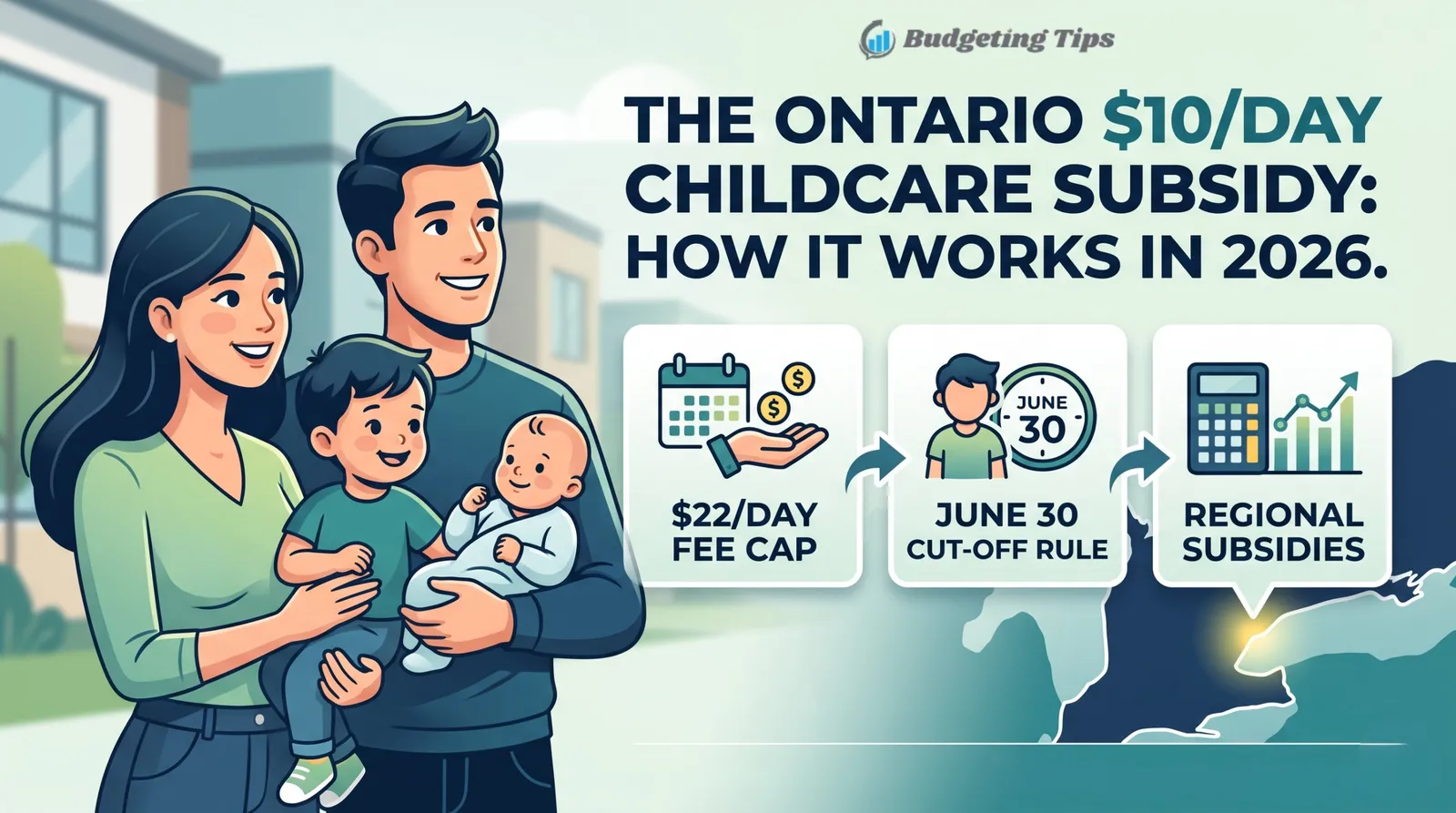
- The Provincial Base Fee Cap: Licensed daycares enrolled in CWELCC have their base fees strictly capped at a maximum of $22 per day.
- The Reality: Because funding is allocated and matched regionally, the actual province-wide out-of-pocket average sits right around $19 per day.
⚠️ Watch out for “Non-Base Fees”: The $22 cap only applies to standard care. Daycares are legally allowed to charge separate, uncapped fees for optional add-ons like field trips, specialized lunch programs, late pickup penalties, or registration administrative charges. Always ask your provider for a breakdown of base vs. non-base fees when reviewing your contract.
2. The “Age-Out” Trap That Catches Parents Off Guard
One of the biggest budgeting surprises for parents is the exact day their child loses eligibility for the lower fee structure. CWELCC funding does not automatically last until your child enters Grade 1. The strict cut-off rule hinges on a specific date: June 30th.
Stage 1: Under Age 6 (Full Eligibility)
Your child receives the full CWELCC fee reduction (capped at $22/day) at any participating licensed center or licensed home daycare layout.
Stage 2: The 6th Birthday (The Transition Window)
When your child turns 6, they do not lose the subsidy immediately. They remain provisionally eligible only until a specific seasonal cutoff.
Stage 3: The June 30th Cut-Off (The Rate Increase)
A child is only covered until June 30th of the calendar year they turn 6. For example, if your child turns 6 in March, your fees will jump to the standard, unsubsidized municipal school-age rate on July 1st.
If your child has a birthday late in the year (e.g., September or December), they will actually age out of the $22/day rate months before they turn 6, because their eligibility expired on June 30th of that year. Make sure to build this rate-jump into your summer cash flow projections.
3. Stacking CWELCC with Regional Subsidies
The $22/day cap is a broad provincial baseline. However, low-to-middle-income families can stack CWELCC with localized Municipal Fee Subsidies to drop their out-of-pocket costs even lower—sometimes down to $0 per day.
These extra subsidies are managed entirely by local municipal managers (like the Region of Peel, City of Toronto, or York Region) rather than the province. They evaluate your household income based strictly on Line 23600 (Net Income) of your previous year’s CRA Notice of Assessment.
📌 Are You a Peel Region Parent?
While Ontario sets the broad provincial guidelines, your true monthly cost depends heavily on localized waitlists and the Region of Peel’s specific income-testing tiers. If you live or work in Mississauga or Brampton, head over to the Childcare & Subsidy Guide to plug in your Line 23600 data and calculate your exact out-of-pocket daily rate under local Peel regulations.
4. Maximizing Your Household Cash Flow
Because childcare costs remain a significant monthly line item even with the subsidies, you should actively sync your daycare strategy with your broader tax planning:
- Leverage the Child Care Expense Deduction: You can claim up to $8,000 per year for children under 7, and $5,000 for kids aged 7 to 16. This is a deduction, meaning it lowers your overall taxable income (Line 23600), which can conversely boost your Canada Child Benefit (CCB) payments for the following year.
- Coordinate the CCB/RRSP Link: If your childcare costs are about to rise due to the June 30th age-out rule, consider increasing your RRSP contributions. Lowering your net income via RRSP contributions directly scales up your monthly CCB tax-free payouts, creating an excellent financial buffer to offset higher school-age care costs.
Keeping a close eye on regional application deadlines and understanding the precise moments your rates change ensures your family budget stays stable, predictable, and fully optimized.
More for Canadian Parents
- The CCB–RRSP Connection: The Strategy Most Canadian Parents Miss
- Personal Finance Tips for Single Parents in Canada
Frequently asked questions
Is Ontario childcare really $10 a day?
Not yet. $10 a day is the target. Right now, licensed daycares in the CWELCC program cap their base fees at $22 a day, and the province-wide average is about $19 a day.
How do I know if my daycare is in the CWELCC program?
Ask the daycare directly or check with your municipality. Only licensed centres and licensed home childcare agencies that have opted in can offer the reduced fees.
When does my child stop qualifying for reduced fees?
Eligibility generally ends on June 30 of the year your child turns six, so a child with a late-year birthday ages out months before their sixth birthday. Plan for full fees after that date.
Can I still claim the child care expense deduction?
Yes. You can deduct up to $8,000 a year for each child under 7 and $5,000 for each child aged 7 to 16 for the fees you actually pay. It is usually claimed by the lower-income spouse.