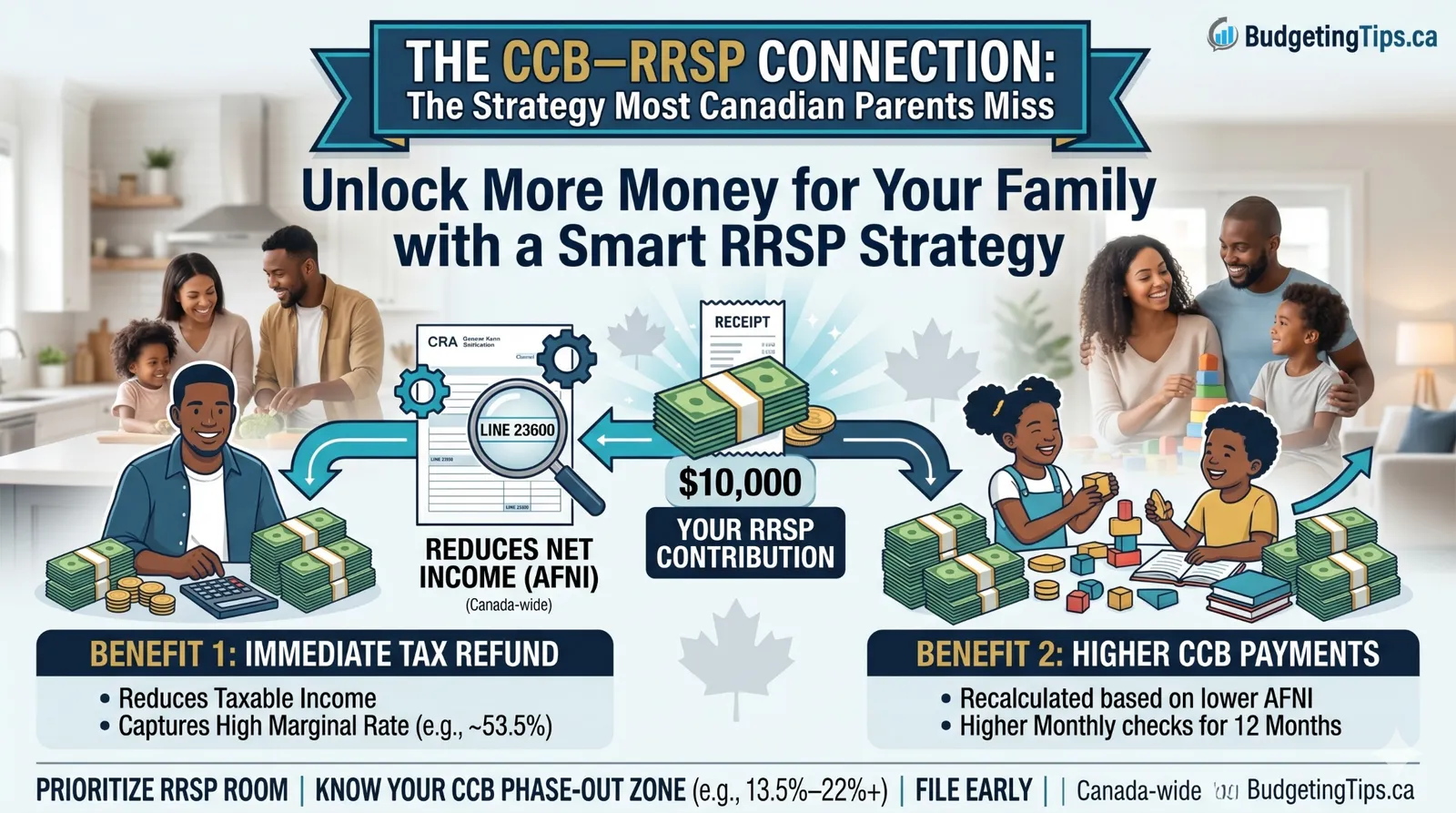
Most people know an RRSP contribution gets you a tax refund. Far fewer know it can also raise your Canada Child Benefit, for a full year. For a family with two kids and a household income around $80,000, a $5,000 RRSP contribution can be worth over $2,000 in the first year between the refund and the extra CCB. That’s a return of more than 40% before your investments earn a cent.
Here’s how the two connect, with the current numbers.
How the Canada Child Benefit works
The CCB is a tax-free monthly payment for families with children under 18 (see our full guide to 2026–2027 Canada Child Benefit payment dates and amounts). For the July 2026 to June 2027 payment year, the maximum is:
| Child’s age | Maximum per year | Maximum per month |
|---|---|---|
| Under 6 | $8,157 | $679.75 |
| 6 to 17 | $6,883 | $573.58 |
The amount you actually get depends on your adjusted family net income (AFNI). That’s the net income (line 23600 of your tax return) of you and your spouse or partner, added together. And it’s always based on the previous year’s return. Payments from July 2026 to June 2027 are based on your 2025 income.
Here’s the key: an RRSP contribution is deducted before line 23600. So it lowers your net income, which lowers your AFNI, which raises your CCB.
How much CCB you lose as income goes up
Once your family net income passes $38,237, your CCB starts to shrink. How fast depends on how many kids you have:
| Number of children | AFNI $38,237 to $82,847 | AFNI over $82,847 |
|---|---|---|
| 1 | 7% | 3.2% |
| 2 | 13.5% | 5.7% |
| 3 | 19% | 8% |
| 4 or more | 23% | 9.5% |
Figures for July 2026 to June 2027. The CRA indexes them every July.
So, a family with two kids and income in the first band loses $135 of CCB for every extra $1,000 of income. Flip that around: every $1,000 you deduct gets $135 back. With three kids, it’s $190.
The double benefit, worked out
A family of four in Ontario
- Spouse A earns $70,000. Spouse B earns $10,000. Family AFNI is $80,000.
- Two children.
- Spouse A contributes $5,000 to their RRSP.
Benefit 1: the tax refund. At $70,000 in Ontario, Spouse A’s combined federal and provincial marginal rate is about 29.65%. A $5,000 deduction saves about $1,483 in tax.
Benefit 2: the CCB boost. Family AFNI drops from $80,000 to $75,000, still inside the 13.5% band. That’s 13.5% × $5,000 = $675 more CCB over the next benefit year.
Total first-year benefit: about $2,158 on a $5,000 contribution. That’s a 43% return, guaranteed by the tax system, before any investment growth. And the money is still yours, sitting in the RRSP.
Which spouse should contribute?
This is where a lot of advice gets it wrong. Because the CCB is based on combined family income, a $5,000 deduction raises your CCB by the same amount whichever spouse makes it. The CCB part of the return is the same either way.
So the question comes down to the tax refund, and that’s bigger for the spouse in the higher tax bracket. In the example above, if Spouse B (earning $10,000) had contributed instead, the family would still get the $675 CCB boost but almost no tax refund, because Spouse B barely pays tax.
The rule of thumb: the higher earner should usually make the contribution, as long as they have the RRSP room.
Spousal RRSP tip: If you want to build retirement savings in the lower earner’s name, the higher earner can contribute to a spousal RRSP. The contributor still gets the deduction at their higher rate, and the family still gets the CCB boost. In retirement, the money comes out in the lower earner’s name, often at a lower tax rate. Just know that withdrawals within three years of a spousal contribution are taxed back to the contributor.
Timing: when does the higher CCB start?
The CCB payment year runs from July to June, based on the previous year’s return. The first 60 days of each year count toward the previous year’s RRSP deduction.
| RRSP contribution made | Deducted on | Raises CCB from |
|---|---|---|
| In 2025, or by March 2, 2026 | 2025 return | July 2026 to June 2027 |
| In 2026, or by March 1, 2027 | 2026 return | July 2027 to June 2028 |
So if you contribute now, before March 1, 2027, the extra CCB starts in July 2027 and lasts a full 12 months. File your return on time so the CRA can recalculate your CCB before July. If you file late, your payments can be delayed or stopped until the return is processed.
How much extra CCB can a family get?
Here’s the extra CCB per year from a $10,000 RRSP deduction, assuming your family income stays within one band:
| Family AFNI | 1 child | 2 children | 3 children | 4+ children |
|---|---|---|---|---|
| $38,237 to $82,847 | $700 | $1,350 | $1,900 | $2,300 |
| Over $82,847 | $320 | $570 | $800 | $950 |
Add the tax refund on top. For a family with three kids in the first band and a contributor at a 29.65% marginal rate, a $10,000 contribution returns roughly $2,965 in tax plus $1,900 in CCB. That’s $4,865 in the first year.
Two limits to keep in mind. If your family income is below $38,237, you’re already getting the full CCB, so an RRSP contribution won’t raise it. And at high incomes, the CCB eventually phases out entirely, so there’s nothing left to recover.
Step by step
- Check your RRSP room. It’s on your Notice of Assessment and in CRA My Account. Unused room carries forward, so you may have more than you think. See RRSP contribution room for 2026.
- Add up your family net income. Both spouses’ line 23600. Compare it to the $38,237 and $82,847 thresholds.
- Decide who contributes. Usually the spouse with the higher marginal tax rate. Check your rate with our Ontario Tax Estimator.
- Model it. The CRA’s child and family benefits calculator shows your CCB at different income levels. Our RRSP calculator shows the refund.
- Contribute before the deadline. March 1, 2027 for the 2026 tax year. If you missed a deadline, see what to do next.
- File on time. Both spouses have to file every year for the family to get the CCB, even a spouse with no income.
- Put the extra CCB to work. Moving it into your child’s RESP gets you the 20% Canada Education Savings Grant on up to $2,500 a year, which is $500 of free money per child. See the RESP guide.
Common mistakes
Assuming the lower earner should contribute “for the CCB.” The CCB boost is the same either way. Let the bigger tax refund decide.
Filing late. No return, no CCB recalculation. Late filing can pause your payments entirely.
Forgetting to re-run the numbers when a new baby arrives. More children means steeper reduction rates, which means each RRSP dollar recovers more CCB.
Thinking a TFSA does the same thing. It doesn’t. See below.
Treating benefits and taxes as separate. Line 23600 also drives the Canada Groceries and Essentials Benefit, the Ontario Trillium Benefit, the Ontario Child Benefit, the Canada Workers Benefit and, later in life, the OAS clawback. One RRSP deduction can nudge all of them in your favour.
RRSP vs TFSA for parents
A TFSA contribution isn’t deductible, so it does nothing to your net income or your CCB. TFSA withdrawals also don’t count as income, which is great in retirement, but it means the TFSA can’t give you the CCB boost.
That doesn’t make the TFSA a bad choice. If your income is low and you pay little tax, or you need the money within a few years, the TFSA often wins. But if your family income is in the CCB phase-out range and you have RRSP room, the RRSP’s double benefit usually makes it the first priority while your kids are young. Then top up your TFSA with whatever’s left. For the full comparison, see TFSA vs RRSP vs FHSA.
The bottom line
If you have kids under 18, family income between about $38,000 and $83,000, and unused RRSP room, an RRSP contribution is one of the best-paying moves available to you. You get a tax refund, a full year of higher CCB, and tax-sheltered growth, all from the same dollars. Have the higher earner contribute, file on time, and put the extra CCB into an RESP.
This article reflects CCB amounts for July 2026 to June 2027 and 2026 federal and Ontario tax rates. The CRA updates the CCB every July, so check canada.ca for current figures, and talk to a tax professional about your own situation.
Related guides
- Canadian Tax Changes for 2026
- RRSP Contribution Room 2026
- 7 Common RRSP Mistakes Canadians Make
- Guide to Budgeting for Families
Frequently asked questions
Does an RRSP contribution increase the Canada Child Benefit?
Yes. The CCB is based on your adjusted family net income, and an RRSP deduction lowers your net income. With two children and family income between $38,237 and $82,847, every $1,000 you contribute adds about $135 a year in CCB, on top of your tax refund.
Which spouse should make the RRSP contribution for the CCB?
The CCB boost is the same no matter which spouse contributes, because it's based on combined family income. So the spouse in the higher tax bracket should usually contribute, because they get the bigger tax refund.
Does a TFSA contribution increase the CCB?
No. TFSA contributions aren't deductible, so they don't change your net income or your CCB. TFSA withdrawals also don't count as income, so they don't reduce it either.
When will a higher CCB start after an RRSP contribution?
In July after you file. A contribution made in 2026 or by March 1, 2027 lowers your 2026 net income, which sets your CCB from July 2027 to June 2028.