The Canada Child Benefit (CCB) is a tax-free monthly payment administered by the Canada Revenue Agency (CRA) to help Canadian families cover the cost of raising children under 18. For millions of households, it is one of the largest recurring deposits in the monthly family budget.
Because the CRA recalculates the benefit every July rather than January, and adjusts both the maximum payouts and income thresholds for inflation each year, it is easy to lose track of what you should actually receive. Below are the 2026 CRA payment dates and expected 2027 schedule, the July 2026 to June 2027 payment amounts and clawback formulas, worked income examples, and provincial top-ups.
Quick summary: 2026–2027 CCB numbers at a glance
For the July 2026 to June 2027 benefit year (calculated from your 2025 tax return):
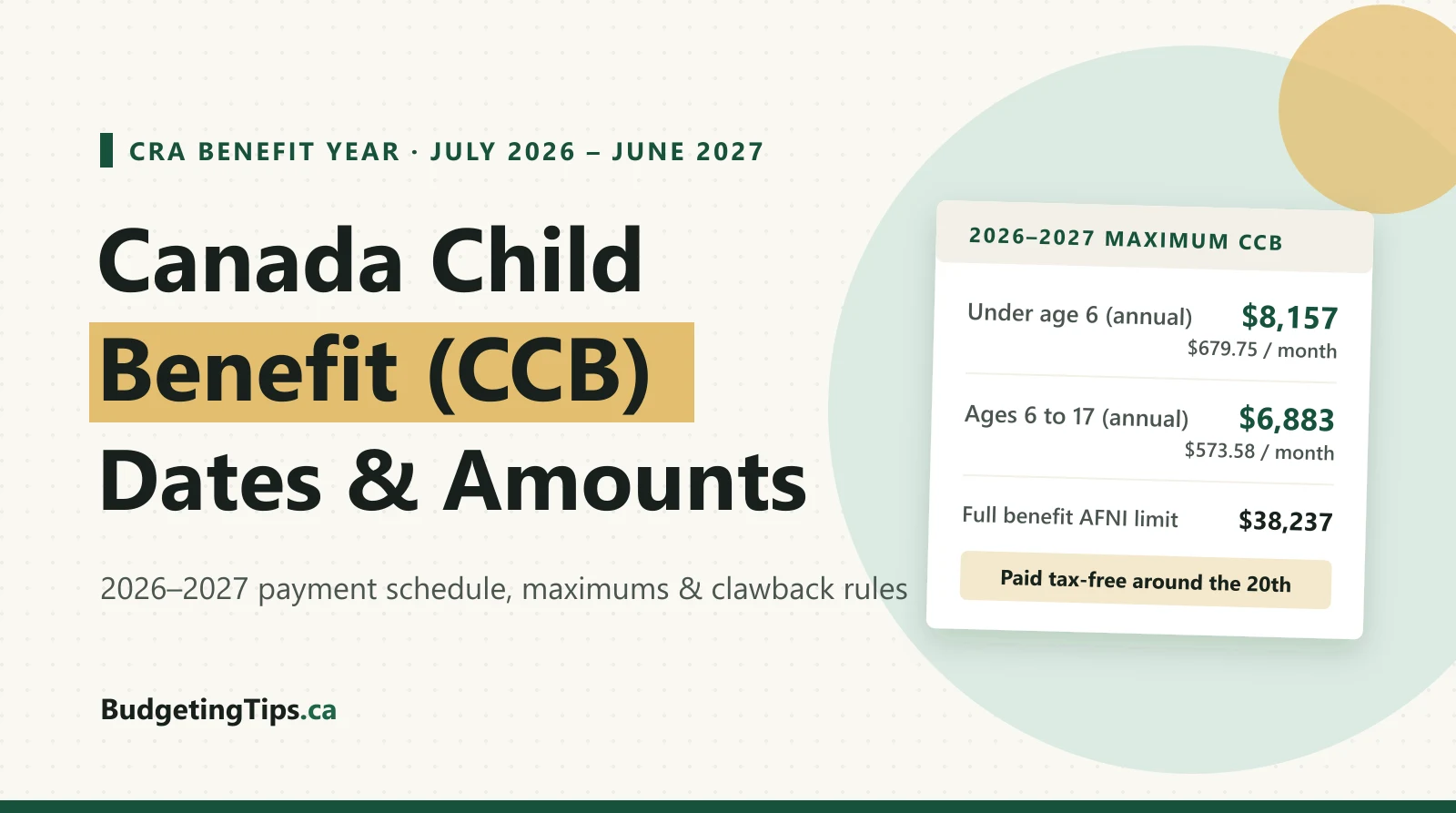
- Child under age 6: Up to $8,157 per year ($679.75 per month)
- Child aged 6 to 17: Up to $6,883 per year ($573.58 per month)
- First income threshold (100% maximum benefit): $38,237 Adjusted Family Net Income (AFNI)
- Second income threshold (tier-two phase-out): $82,847 AFNI
- Child Disability Benefit (CDB) supplement: Up to $3,480 per year ($290.00 per month) per eligible child
CCB payment dates for 2026 and expected dates for 2027
The CRA issues Canada Child Benefit payments on the 20th of each month, as listed on the Government of Canada benefit payment calendar. Whenever the 20th lands on a weekend or a federal statutory holiday, the deposit arrives on the last business day before the 20th. In December, the payment arrives earlier in the month ahead of the winter holidays.
The CRA’s payment dates page currently lists the confirmed 2026 schedule. The 2027 column below shows the expected payment dates based on the CRA’s standard 20th-of-the-month rule.
| Month | 2026 Payment Date (CRA) | 2027 Expected Date | Benefit Year & Base Tax Return |
|---|---|---|---|
| January | January 20, 2026 | January 20, 2027 | Prior July recalculation |
| February | February 20, 2026 | February 19, 2027 (Fri) | Prior July recalculation |
| March | March 20, 2026 | March 19, 2027 (Fri) | Prior July recalculation |
| April | April 20, 2026 | April 20, 2027 | Prior July recalculation |
| May | May 20, 2026 | May 20, 2027 | Prior July recalculation |
| June | June 19, 2026 (Fri) | June 18, 2027 (Fri) | Final payment of benefit year |
| July | July 20, 2026 | July 20, 2027 | New benefit year begins |
| August | August 20, 2026 | August 20, 2027 | Current July recalculation |
| September | September 18, 2026 (Fri) | September 20, 2027 | Current July recalculation |
| October | October 20, 2026 | October 20, 2027 | Current July recalculation |
| November | November 20, 2026 | November 19, 2027 (Fri) | Current July recalculation |
| December | December 11, 2026 (Early) | Mid-December 2027 (Early, TBA) | Current July recalculation |
Note: If your total annual CCB entitlement for the benefit year is under $240 (less than $20 a month), the CRA does not send monthly deposits. Instead, it pays the entire annual amount as a single lump sum with the July payment.
If you are enrolled in CRA direct deposit, the money lands in your bank account on the payment date. If you receive a paper cheque, allow up to 10 business days for mail delivery before contacting the CRA at 1-800-387-1193.
How much is the Canada Child Benefit in 2026–2027?
Every July, the CRA indexes the CCB to Consumer Price Index (CPI) inflation. For payments issued between July 2026 and June 2027, the CRA calculation rules start with two base maximums:
| Child’s Age Group | Annual Maximum (2026–2027) | Monthly Maximum (2026–2027) | Up From 2025–2026 |
|---|---|---|---|
| Under 6 years old | $8,157 | $679.75 | $7,997 ($666.41/mo) |
| 6 to 17 years old | $6,883 | $573.58 | $6,748 ($562.33/mo) |
Two age transitions happen automatically during the year:
- Turning 6: Your child receives the under-6 rate ($679.75/month) up to and including the month of their 6th birthday, and switches to the 6-to-17 rate ($573.58/month) the following month.
- Turning 18: Your final CCB payment for that child is issued in the month they turn 18.
How the CRA income thresholds and clawback work
Your actual monthly deposit depends on your Adjusted Family Net Income (AFNI), which is Line 23600 (Net Income) from your tax return plus Line 23600 from your spouse’s or common-law partner’s tax return, minus any Universal Child Care Benefit (UCCB) or Registered Disability Savings Plan (RDSP) income received (plus any UCCB or RDSP amounts repaid).
For the July 2026 to June 2027 payment period, the CRA uses your 2025 AFNI and applies two income thresholds: $38,237 and $82,847.
| Number of Eligible Children | AFNI $38,237 or Less | AFNI $38,237 to $82,847 (Band 1 Reduction) | AFNI Over $82,847 (Band 2 Reduction) |
|---|---|---|---|
| 1 child | $0 reduction (full max) | 7.0% of AFNI over $38,237 | $3,123 + 3.2% of AFNI over $82,847 |
| 2 children | $0 reduction (full max) | 13.5% of AFNI over $38,237 | $6,022 + 5.7% of AFNI over $82,847 |
| 3 children | $0 reduction (full max) | 19.0% of AFNI over $38,237 | $8,476 + 8.0% of AFNI over $82,847 |
| 4 or more children | $0 reduction (full max) | 23.0% of AFNI over $38,237 | $10,260 + 9.5% of AFNI over $82,847 |
A quick worked example
Suppose you have two children, one age 3 and one age 8, and your 2025 Adjusted Family Net Income was $75,000:
- Maximum base benefit: $8,157 (age 3) + $6,883 (age 8) = $15,040/year.
- Income above the $38,237 threshold: $75,000 − $38,237 = $36,763.
- Reduction (2 children in Band 1 = 13.5%): $36,763 × 13.5% = $4,963/year.
- Net annual CCB: $15,040 − $4,963 = $10,077/year, or $839.75/month tax-free.
Sample 2026–2027 monthly CCB payouts by family income
To help you estimate where your household lands, here is what the 2026–2027 formula pays per month across common Canadian family income levels:
| Adjusted Family Net Income (AFNI) | 1 Child (Under 6) | 1 Child (Aged 6–17) | 2 Children (One Under 6, One 6–17) | 3 Children (One Under 6, Two 6–17) |
|---|---|---|---|---|
| $35,000 | $679.75 / mo | $573.58 / mo | $1,253.33 / mo | $1,826.92 / mo |
| $55,000 | $581.97 / mo | $475.80 / mo | $1,064.75 / mo | $1,561.50 / mo |
| $75,000 | $465.30 / mo | $359.13 / mo | $839.75 / mo | $1,244.83 / mo |
| $95,000 | $387.12 / mo | $280.95 / mo | $693.75 / mo | $1,039.57 / mo |
| $120,000 | $320.45 / mo | $214.28 / mo | $575.00 / mo | $872.91 / mo |
| $150,000 | $240.45 / mo | $134.28 / mo | $432.50 / mo | $672.91 / mo |
Figures are federal CCB amounts rounded to the nearest cent based on the 2026–2027 CRA formula. Provincial benefits are added on top for qualifying lower- and modest-income households.
The Child Disability Benefit (CDB) supplement
If your child has a severe and prolonged impairment in physical or mental functions and has been approved by the CRA for the Disability Tax Credit (DTC) via Form T2201, the CRA automatically adds the tax-free Child Disability Benefit to your monthly CCB deposit.
For July 2026 to June 2027:
- Maximum annual CDB: $3,480 per eligible child ($290.00 per month).
- Full CDB income threshold: Families with AFNI of $82,847 or less receive the full $290.00/month supplement on top of their regular CCB.
- Reduction above $82,847: Reduced by 3.2% of AFNI over $82,847 for one DTC-eligible child, or 5.7% of AFNI over $82,847 if two or more children qualify.
If your child is approved for the DTC retroactively, the CRA automatically issues retroactive CDB payments for the current benefit year and the two previous benefit years. For earlier benefit years, you can send a written request to your tax centre.
Provincial and territorial top-ups paid with the CCB
In most provinces and territories (except Quebec, where Retraite Québec administers the separate Family Allowance payment), the CRA combines provincial child benefits into the same monthly deposit, or issues them alongside the federal schedule. Below are the 2026–2027 figures for the three largest provincial programs administered by the CRA:
| Provincial Program | 2026–2027 Maximum Amount | Full-Benefit AFNI Threshold | Phase-Out Rule & Payment Frequency |
|---|---|---|---|
| Ontario Child Benefit (OCB) | $146.66/mo (about $1,760/yr) per child | $26,865 | Reduced by 8% of AFNI over $26,865; combined with monthly CCB |
| BC Family Benefit (BCFB) | $1,750/yr (1st child), $1,100 (2nd), $900 (3rd+) + up to $500 single-parent top-up | $30,176 | Reduced by 4% over $30,176 to a minimum of $775 / $750 / $725 up to $96,562, then reduced by 4% above $96,562; combined with monthly CCB |
| Alberta Child & Family Benefit (ACFB) | Up to $2,311/yr (1 child), $3,787 (2), $4,977 (3), $5,882 (4+) (Base + Working) | $28,116 (Base) / $47,115 (Working) | Paid separately in 4 quarterly instalments (August, November, February, May) |
How the BC Family Benefit two-stage reduction works
Unlike the Ontario Child Benefit, which phases out in a single straight line above $26,865, the BC Family Benefit has a guaranteed middle-income floor:
- AFNI $30,176 or less: You receive the full maximum ($1,750 for your first child, $1,100 for your second, and $900 for each additional child).
- AFNI between $30,176 and $96,562: Your maximum benefit is reduced by 4% of the portion of income over $30,176, but you are guaranteed at least $775 per year for your first child, $750 for your second child, and $725 for each additional child.
- AFNI above $96,562: Those reduced minimum amounts ($775 / $750 / $725) are reduced by 4% of the portion of income above $96,562 until the benefit reaches zero.
Shared custody and marital status changes
Two life events trigger immediate recalculations of your CCB, and failing to report them promptly is the single most common reason parents get hit with a CRA overpayment bill:
1. Shared custody (the 40% to 60% rule)
When separated or divorced parents share custody of a child roughly equally, meaning the child lives with each parent between 40% and 60% of the time (such as week-on/week-off or a 2-2-3 schedule), the CRA classifies both parents as eligible shared-custody individuals.
Neither parent gets 100% of the benefit, and parents cannot privately agree to have one parent claim the whole amount if actual custody is 50/50. Instead:
- The CRA calculates what Parent A would receive at 100% custody using Parent A’s AFNI, and pays Parent A 50% of that amount.
- The CRA calculates what Parent B would receive at 100% custody using Parent B’s AFNI, and pays Parent B 50% of that amount.
If the child lives with one parent more than 60% of the time, that parent is considered the primary caregiver and receives 100% of the CCB. We cover more ways single-income households can stretch monthly cash flow in personal finance tips for single parents in Canada.
2. Moving in with a partner or separating
For CRA tax purposes, you become common-law partners after living together in a conjugal relationship for 12 continuous months, or immediately if you share a child by birth or adoption. You must update your marital status in CRA My Account by the end of the month following the month your status changed (or after 90 days of living apart for a separation). The CRA will recalculate your remaining monthly CCB deposits starting the month after the status change.
How to increase your CCB payment legally
Because the CCB is calculated strictly from Line 23600 (Net Income) rather than gross income, any tax deduction that lowers Line 23600 reduces your Adjusted Family Net Income and increases your CCB for the entire following July-to-June benefit year:
- RRSP contributions: Every $1,000 contributed to an RRSP by a family with an AFNI between $38,237 and $82,847 boosts next year’s tax-free CCB by $70 (1 child), $135 (2 children), $190 (3 children), or $230 (4+ children), on top of your regular income tax refund. Read our complete breakdown in The CCB and RRSP Connection and test your refund in the RRSP Calculator.
- FHSA contributions: If you qualify as a first-time home buyer, deductible contributions to a First Home Savings Account (FHSA) also reduce Line 23600 net income dollar-for-dollar.
- Childcare expense deductions (Form T778): Claiming eligible daycare, camp, and after-school costs lowers the lower-earning spouse’s net income on Line 23600, which simultaneously boosts the family’s CCB. Even if your child attends a subsidized centre (see how the $10-a-day childcare subsidy works in Ontario), always keep your annual receipts and claim every dollar you paid out of pocket.
How to put your monthly CCB deposit to work
Because the CCB arrives on a predictable schedule around the 20th of every month, the easiest way to make it count is to give the deposit a job before it blends into everyday spending:
- Cover core child expenses first: Slot your exact monthly CCB deposit into the income side of the monthly budget calculator to offset groceries, childcare, and clothing.
- Automate the 20% RESP grant: Contributing $208.33 a month ($2,500/year) per child into a Registered Education Savings Plan unlocks the full $500 annual Canada Education Savings Grant (CESG), plus an extra $50 to $100 in Additional CESG if your AFNI is under $117,045, and up to $2,000 from the Canada Learning Bond for lower-income families with zero contribution required. Set your automatic transfer for the 21st of each month right after the CCB lands. See our complete RESP guide for Canadian parents for step-by-step numbers.
- File both tax returns on time every spring: Both you and your spouse or common-law partner must file a Canadian tax return every year, even if one partner earned $0, or the CRA will automatically pause your CCB payments in July. Check our Canadian tax changes guide and year-end money checklist so nothing slips through the cracks.
This guide uses Canada Revenue Agency (CRA) figures for the July 2026 to June 2027 benefit year (based on 2025 tax returns) and the 2026 federal payment schedule. It is general information, not personal tax or financial advice. Verify your household’s exact entitlement in CRA My Account.
Related guides
- The CCB and RRSP Connection: The Strategy Most Canadian Parents Miss
- RESP Guide for Canadian Parents: How to Get All $7,200 in Grants
- Guide to Budgeting for Families in Canada
- $10-a-Day Childcare Subsidy in Ontario: What You Actually Pay
Frequently asked questions
What is the maximum Canada Child Benefit for 2026–2027?
For the July 2026 to June 2027 benefit year, the maximum federal CCB is $8,157 per year ($679.75 per month) for each eligible child under age 6, and $6,883 per year ($573.58 per month) for each eligible child aged 6 to 17. Families with an adjusted family net income (AFNI) of $38,237 or less receive the full maximum amount.
When are the CCB payment dates for the rest of 2026 and 2027?
The CRA normally issues CCB payments on the 20th of each month, or the last business day before the 20th if it falls on a weekend or federal holiday. The final two confirmed payments of 2026 are November 20, 2026 and December 11, 2026 (issued early for the holidays). Based on the CRA's 20th-of-the-month rule, expected 2027 payments for the remainder of the benefit year fall on January 20, February 19, March 19, April 20, May 20, and June 18, before the new benefit year begins on July 20, 2027.
At what income does the Canada Child Benefit stop completely?
There is no single fixed cut-off because the phase-out depends on how many children you have and their ages. For the July 2026 to June 2027 benefit year, a family with one child aged 6 to 17 phases out completely at an adjusted family net income of about $200,356, while a family with one child under 6 phases out at about $240,169. Families with two or more children continue receiving partial CCB at higher incomes.
Why did my Canada Child Benefit amount change in July?
The CCB benefit year runs from July 1 to June 30, not January to December. Every July, the CRA recalculates your monthly payment using the adjusted family net income from your previous year's tax return (for example, your 2025 tax return sets your payments from July 2026 to June 30, 2027). Your payment also drops the month after a child turns 6, and stops the month after a child turns 18.
How does shared custody affect the Canada Child Benefit?
If a child lives with each separated parent between 40% and 60% of the time, the CRA treats both parents as shared-custody caregivers. Each parent receives 50% of the CCB payment they would have received if the child lived with them full-time, calculated separately using each parent's own adjusted family net income.
Is the Canada Child Benefit taxable?
No. The Canada Child Benefit, along with the Child Disability Benefit and provincial top-ups like the Ontario Child Benefit and BC Family Benefit, is completely tax-free. You do not report it as income on your tax return, and it does not reduce other income-tested benefits.